
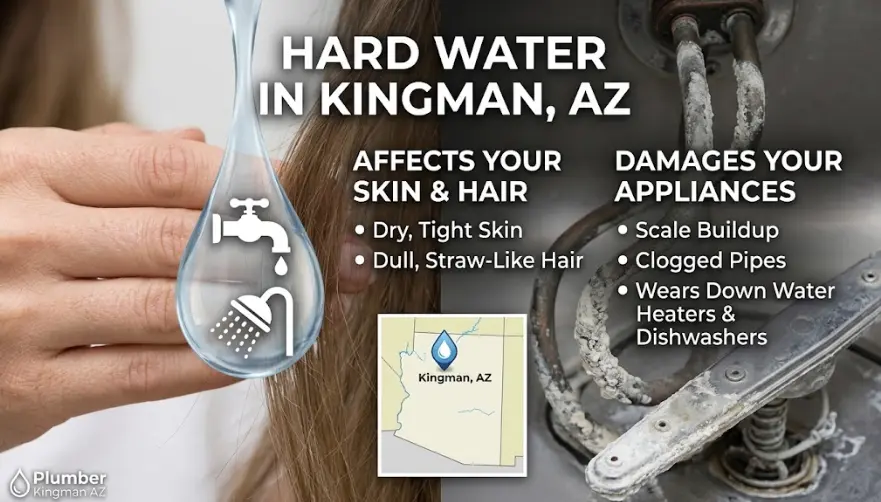
How Hard Water Affects Your Skin, Hair & Appliances | Kingman, AZ
Meta Description: Hard water in Kingman, AZ dries out skin and hair and wears down appliances fast. Learn the warning signs, fixes, and when to call a plumber.
If your skin feels tight after a shower or your dishwasher keeps leaving spots on glasses, hard water is probably the reason. Kingman sits on groundwater drawn largely from the Hualapai Valley basin, and that water carries a heavy load of dissolved calcium and magnesium. The result shows up on your body and in your appliances long before it shows up on a water bill.
This guide breaks down exactly what hard water does to skin, hair, and household equipment, and what you can do about it.
Table of Contents
What Hard Water Actually Is
Hard water contains high levels of dissolved minerals, mainly calcium and magnesium, measured in grains per gallon (GPG). Anything above 7 GPG is considered hard; Kingman-area water often tests well above that mark. According to the <cite index=”0-1″>United States Geological Survey, hard water is common in the United States and is generally not a health hazard, though it does create practical household problems</cite>.
Those minerals don’t dissolve away when water heats up or evaporates. Instead, they bond with soap, cling to skin and hair, and build up as scale inside pipes and appliances. The USGS notes that hard water is widespread across the U.S. and is not a health hazard on its own, but it does create the practical household problems covered below. For a deeper look at why the Hualapai Valley basin produces such mineral-heavy water, see our earlier post on why Kingman, AZ has hard water and what it does to your pipes.
How Hard Water Affects Your Skin
Calcium and magnesium react with soap to form a sticky residue called soap scum. That film sits on your skin instead of rinsing away.
Common effects include:
- Dry, tight, or flaky skin after showering
- Soap and shampoo that won’t lather properly
- Worsened eczema or existing skin sensitivity
- Clogged pores from mineral and soap buildup
- Skin feeling filmy even after rinsing
The residue also strips the skin’s natural oils over time, which is why people with hard water often reach for heavier moisturizers than they used to need.
How Hard Water Affects Your Hair
Hair reacts to hard water much the same way skin does. Minerals coat each strand, making it harder for shampoo to clean and for conditioner to actually condition.
Typical signs:
- Hair feels dull, straw-like, or heavy
- Color-treated hair fades faster
- Increased frizz and tangling
- Scalp dryness or itchiness
- Shampoo lathers poorly no matter the brand
Over months and years, mineral buildup can also make hair more prone to breakage, since the coating makes strands stiffer and less flexible.
How Hard Water Damages Appliances
This is where hard water gets expensive. Every time water heats or evaporates, dissolved minerals are left behind as scale. That scale builds up inside pipes, valves, and heating elements.
| Appliance | Common Hard Water Damage |
|---|---|
| Water heater | Sediment layer reduces efficiency, shortens tank life |
| Dishwasher | Cloudy glassware, clogged spray arms, shorter lifespan |
| Washing machine | Stiff fabrics, reduced detergent effectiveness, valve buildup |
| Coffee maker / kettle | Scale clogs internal lines, slows heating |
| Faucets & showerheads | Reduced water flow, visible white crust |
Water heaters take the biggest hit. Scale acts as insulation between the burner or element and the water, forcing the unit to work harder and wear out sooner. We cover this in detail in how hard water shortens your water heater’s life, including how much faster tanks fail in high-GPG areas like Kingman.
How to Reduce the Damage
You can’t remove hard water minerals by boiling or filtering through a standard pitcher filter, but a few practical steps limit the damage:
- Use a shampoo/conditioner made for hard water to cut through mineral buildup.
- Apply moisturizer within a few minutes of showering while skin is still slightly damp.
- Descale appliances monthly with a vinegar or manufacturer-approved descaling solution.
- Flush your water heater every 6–12 months to clear sediment before it hardens.
- Install faucet aerators with removable screens so mineral buildup is easy to clean out.
These steps help, but they treat the symptoms. The only way to stop scale from forming in the first place is to treat the water before it reaches your fixtures and appliances — typically with a water softener. If you’re weighing that option, our comparison of water softener vs. water filtration explains which approach fits different household needs, and signs you need a water softener covers the warning signs beyond skin and appliance issues.
When to Call a Plumber
Most hard water symptoms are a nuisance, but a few situations call for a professional:
- Your water heater is making popping or rumbling sounds (sediment buildup)
- Water flow has noticeably dropped at multiple fixtures
- You see white or greenish crust forming around fittings or valves
- An appliance has stopped heating water properly
- You want a professional assessment of your home’s water hardness level
A plumber can flush your water heater, inspect fixtures for scale damage, and advise on treatment options suited to Kingman’s water conditions. For heater-specific symptoms, our tankless water heater repair team can diagnose scale-related performance issues directly.
Prevention Tips
- Test your water’s hardness level (many local providers offer free testing)
- Flush the water heater on a regular schedule, not just when problems appear
- Clean showerheads and faucet aerators every few months
- Use appliance-safe descaling products as part of routine maintenance
- Consider whole-home water treatment if symptoms are severe or worsening
FAQs
Is hard water dangerous to drink or shower in?
No. The EPA classifies hardness as a secondary, aesthetic concern rather than a health risk, though it can still irritate sensitive skin over time.
Why does my skin feel worse in Kingman than it did elsewhere?
Kingman’s groundwater, drawn from the Hualapai Valley basin, tends to carry higher mineral content than many other regions, which intensifies the soap-residue effect on skin and hair.
Can a water filter fix hard water issues?
Standard filters remove sediment, chlorine, or odor, but most don’t remove calcium and magnesium. Softening, not filtering, addresses hardness directly.
How fast does hard water damage a water heater?
It varies by usage and hardness level, but sediment buildup in high-GPG areas can noticeably shorten a tank’s efficient lifespan compared to homes with softened water.
Will switching shampoo really make a difference?
It helps reduce buildup on hair, but it doesn’t stop scale from forming in pipes or appliances — that requires treating the water itself.
If dry skin, dull hair, or scaled-up appliances have become a regular issue in your Kingman home, a licensed plumber can assess your water heater and fixtures and point you toward the right fix. Contact us at Plumber Kingman AZ to schedule an inspection.